


 Login/Register


Trying to pick the right outboard motor can be really tough. For a lot of boaters, the big debate right now is the Yamaha F25 vs Mercury 30 HP. Both are great engines, so it’s important to look closely before you buy. But it always comes down to the same question: Which outboard is best? Yamaha or Mercury?
In this guide, we’ll break down the matchup between the Yamaha F25 vs Mercury 30 HP to help you choose the right one and avoid a costly mistake.
On one side, you have the 2025 Yamaha F25SWHC3. This is a 25 horsepower outboard that comes in a cool, exclusive brown color. It has a 15-inch shaft and gives you the peace of mind of having both an electric start and a manual backup.
Email : boatenginessales@gmail.com
On the other side is the 2026 Mercury FourStroke 30 HP. This engine is all about power, giving you a full 30 horsepower for getting up to speed quickly. It features a longer 20-inch shaft and modern EFI for reliable starts.
So, how do you decide? Is the extra power from the Mercury what you need, or do the unique features of the Yamaha make more sense for your boat? This review will compare them side-by-side. Let’s dive into the Yamaha F25 vs Mercury 30 HP showdown and help you figure out for yourself: Which outboard is best? Yamaha or Mercury? yamaha f25 review
Contact – boatenginessales@gmail.com
Introduction of Outboard Motors :
An outboard motor is the engine that clamps onto the back of a boat. It’s an all-in-one unit that includes the engine, propeller, and steering mechanism. This design makes them easy to attach and use on a wide variety of boats. Outboards are available in many different sizes, from small, portable engines perfect for dinghies to very large, powerful motors used on bigger vessels.
Importance of Choosing the Right Outboard :
Picking the right outboard motor is one of the most critical decisions for any boat owner. The engine is the heart of your boat, and your choice will directly affect almost every aspect of your time on the water. Here’s why it matters so much:
- Performance and Handling: The right motor ensures your boat performs as it was designed to. If an engine is underpowered, the boat will feel sluggish, struggle to get “on plane” (lifting to skim across the top of the water), and won’t handle well, especially with passengers or gear. An overpowered engine can make the boat difficult to control and unstable.
- Safety: This is the most important factor. Every boat has a manufacturer’s capacity plate that states the maximum horsepower it can safely handle. Exceeding this limit can put too much stress on the boat’s structure, particularly the back wall (the transom), and create a serious risk of accidents. A reliable, correctly sized motor ensures you have enough power to handle changing conditions and get back to shore safely.
- Fuel Efficiency and Cost: A properly matched outboard runs more efficiently. An engine that is too small has to work constantly at high power, burning more fuel and wearing out faster. A modern, correctly sized engine will provide the best fuel economy, saving you a significant amount of money over the life of the motor.
- Overall Enjoyment: The goal of boating is to have fun. A good engine starts reliably, runs smoothly, and is relatively quiet. A mismatched or poor-quality engine can lead to constant frustration with hard starts, excessive noise, and vibration, which ruins the experience on the water.
- Protecting Your Investment: A boat and motor are significant investments. The right outboard protects the boat from damage caused by overpowering and ensures the engine itself isn’t being overworked, which leads to a longer lifespan for both. This helps maintain the value of your entire setup.
In short, the right outboard makes boating safe, fun, and cost-effective. Taking the time to choose wisely is essential for a positive boating experience.
Yamaha F25 Overview: Lightweight Champion, Heavy on Features
The Yamaha F25 stands out as a lightweight champion that’s heavy on features, making it a top choice for jon boats, inflatables, and small fishing vessels. Its main advantage is the advanced battery-less Electronic Fuel Injection (EFI), which provides easy starts and excellent fuel efficiency without needing a heavy battery on board.

Weighing only 126 pounds, the F25 is incredibly easy to handle, yet its 432cc twin-cylinder engine delivers a punchy, responsive performance that gets boats on plane quickly. True to Yamaha’s reputation, it’s an exceptionally reliable and durable motor, making it a smart investment for boaters who need a powerful yet portable engine.
The Yamaha F25 Advantage: What Sets It Apart
The Yamaha F25 isn’t just another engine; it’s a carefully designed package of technology and user-friendly features. Here’s a look at what makes it a standout choice in its class.

Engine and Performance :
- Battery-Less Electronic Fuel Injection (EFI): This is the standout feature. It provides quick, reliable starts and excellent fuel efficiency without the need for a starting battery, making it perfect for simpler boat setups.
- Impressive Power-to-Weight Ratio: The 432cc twin-cylinder engine delivers strong acceleration and a punchy feel, getting boats on plane quickly despite the engine’s low overall weight.
- Smooth and Quiet Operation: As a four-stroke engine, it runs smoothly and is significantly quieter than older two-stroke models, making for a more pleasant experience on the water.
Portability and Design :
- Class-Leading Low Weight: Weighing as little as 126 pounds, it is one of the lightest 25 horsepower outboards available, making it much easier to carry, transport, and mount on a boat.
- Ergonomic Carrying Handles: The engine has built-in, strategically placed handles that make it easier and more comfortable to lift and carry.
- Side Storage Resting Pads: The cowling is designed with durable resting pads that allow you to store the engine on its side without worrying about scratching the finish or causing oil to leak.
Convenience and Usability :
- Dual Start System: Many models come with both a convenient electric start and a reliable manual pull-start, providing a crucial backup in case of a battery issue.
- Freshwater Flushing Port: An easily accessible hose connection allows you to flush saltwater and debris from the cooling passages without having to start the engine, simplifying maintenance and extending the engine’s life.
- Tiller Handle Control: The tiller handle is designed to be ergonomic and reduce vibration, offering direct and comfortable control of steering and throttle.
Features for Anglers :
- Variable Trolling RPM Switch (VTS): This feature is a major benefit for fishing. It allows you to adjust the engine’s trolling speed in precise, small increments, helping you find the perfect speed for your lure presentation.
Yamaha F25 Performance Breakdown: Speed, Fuel Use, and Handling
The true measure of any outboard is how it performs on the water. The Yamaha F25 is engineered not just to be reliable, but to provide a responsive and efficient ride. Here’s how it measures up in key performance areas.
Speed and Acceleration :
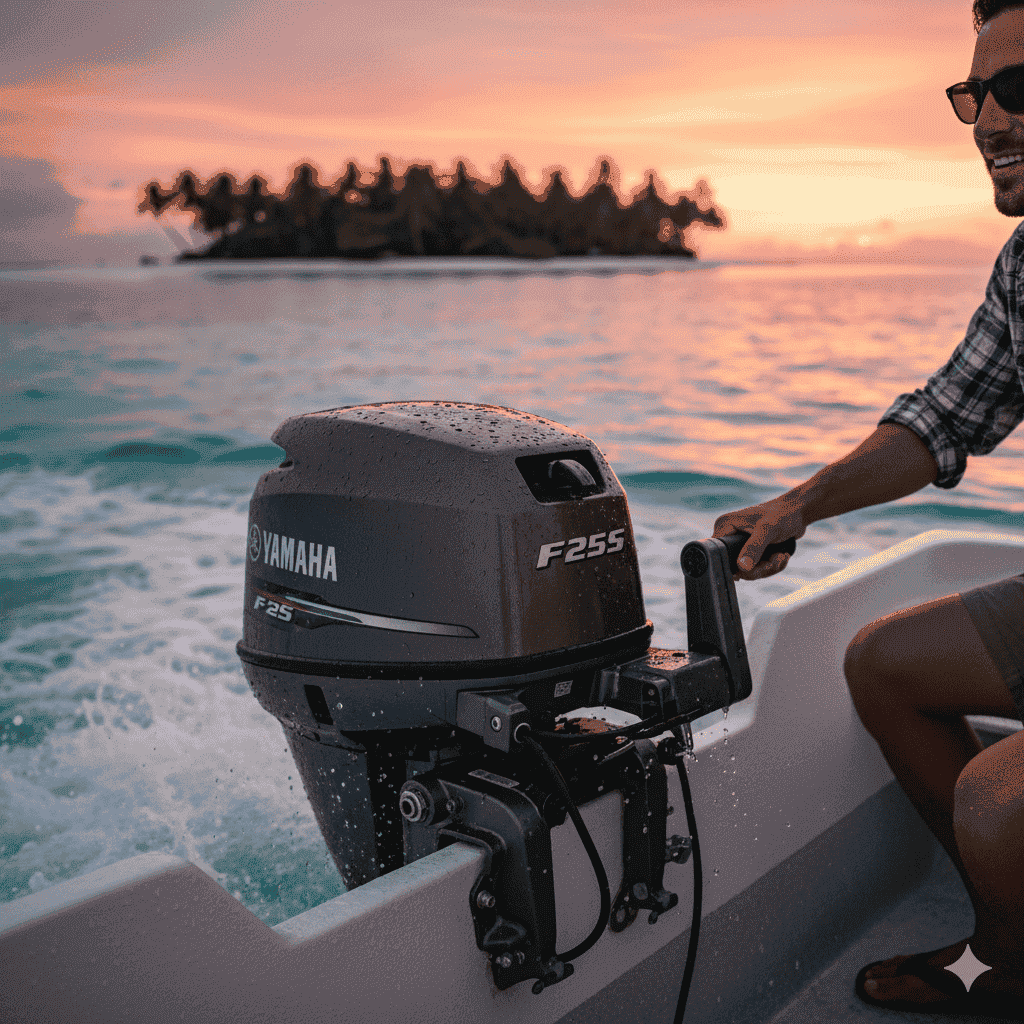
The Yamaha F25 is a 25 horsepower, 432cc twin-cylinder engine known for its quick and responsive performance.
- Acceleration: Thanks to its excellent power-to-weight ratio, the F25 delivers a strong “hole shot,” meaning it gets the boat moving and up on plane very quickly. Users often describe it as feeling punchy and more powerful than its horsepower rating might suggest.
- Top Speed: While the exact top speed depends heavily on the boat’s size, weight, and conditions, the F25 can typically push a small aluminum fishing boat or inflatable to speeds of 20-25 miles per hour (approximately 17-22 knots).
Fuel Efficiency :
This is one of the strongest performance areas for the Yamaha F25, primarily due to its Electronic Fuel Injection (EFI) system.
- Fuel Consumption: The F25 is incredibly fuel-efficient. At cruising speed, it sips gasoline, allowing for a very long range on a standard portable fuel tank. Many owners report being surprised at how little fuel they use during a full day on the water.
- Efficiency at All Speeds: The EFI system optimizes the fuel-to-air mixture across the entire RPM range. This means it’s extremely economical at slow trolling speeds and still maintains good efficiency even when running at full throttle.
Handling and Maneuverability :
The F25 is designed to be agile and easy to control, making it ideal for navigating different types of waterways.
- Steering: With its tiller handle, the engine provides direct and responsive steering. It has a wide steering angle, allowing for sharp, tight turns which is very useful when docking or maneuvering in crowded areas.
- Trolling Control: For anglers, the optional Variable Trolling RPM Switch (VTS) is a key performance feature. It allows the operator to adjust the engine’s idle speed in precise 50-RPM increments, providing ultimate control for slow trolling.
Noise and Vibration :
As a modern four-stroke engine, the F25 performs very well in terms of comfort and quiet operation.
- Noise Level: The engine is very quiet at idle and trolling speeds, allowing for normal conversation without shouting. At cruising speed, the sound is smooth and not overpowering. It is significantly quieter than any older two-stroke engine.
- Vibration: Vibration is minimal. Like most two-cylinder engines, there can be a slight vibration right at idle, but it smooths out immediately as soon as you increase the throttle and is virtually unnoticeable during normal operation.
Built to Last: Yamaha F25 Reliability and Durability
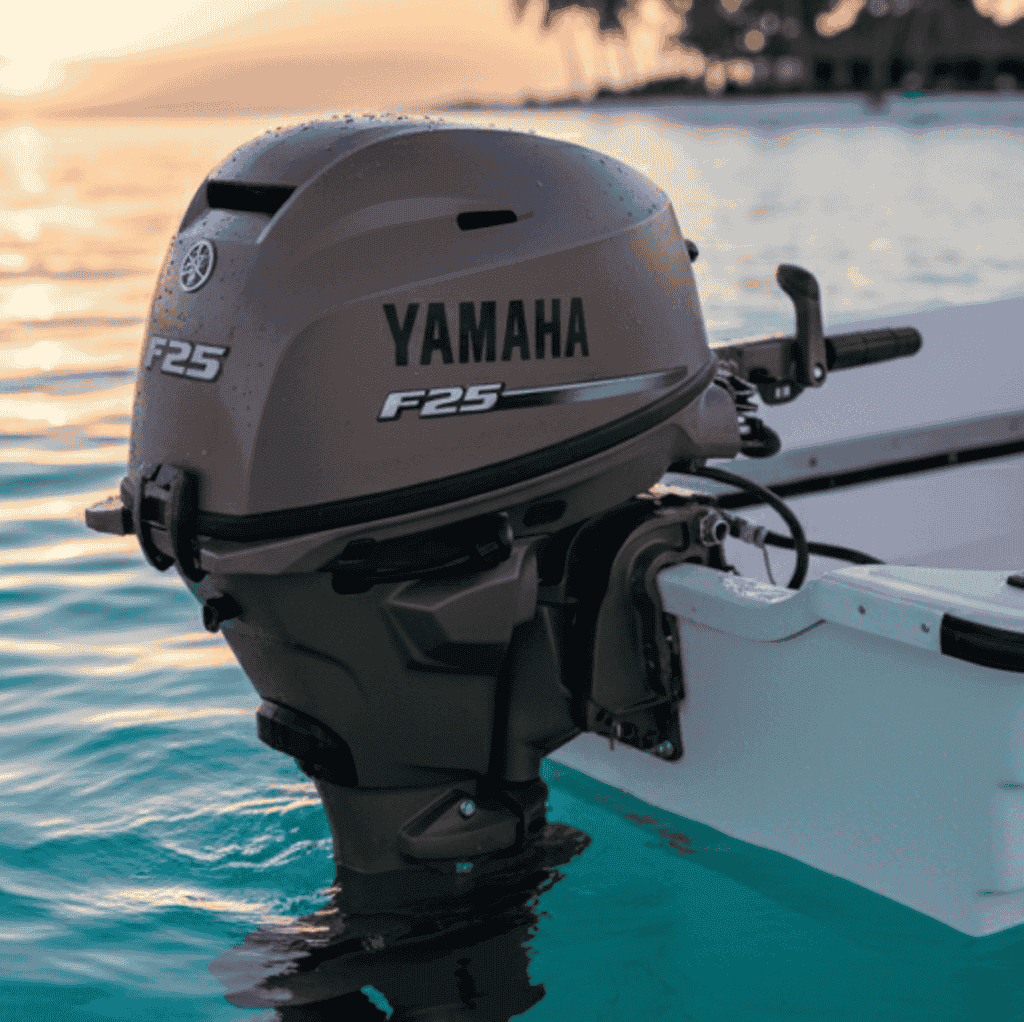
Yamaha has earned a worldwide reputation for building engines that you can count on, and the F25 is a perfect example of this commitment. Its reliability isn’t just a claim; it’s the result of smart design, robust materials, and proven technology.
Build Quality and Corrosion Resistance :
- Materials: Yamaha uses a proprietary YDC-30 aluminum alloy, which is highly resistant to saltwater corrosion.
- Paint Process: The engine is protected by multiple layers of paint, including a tough primer and a final clear coat, which provides a durable barrier against the elements.
- Sacrificial Anodes: It is equipped with sacrificial anodes in key locations. These components are designed to corrode first, protecting more vital and expensive engine parts from galvanic corrosion.
- Stainless Steel Components: Critical components like the driveshaft, propeller shaft, and shift shaft are made from high-quality stainless steel for maximum strength and corrosion resistance.
Engine Design and Technology :
- Proven Four-Stroke Design: The four-stroke engine design is inherently reliable, known for its longevity and smooth operation compared to older engine types.
- Solid-State EFI System: The battery-less Electronic Fuel Injection system has fewer moving parts than a traditional carburetor. This greatly increases reliability by eliminating common fuel-related issues like clogged jets and choke problems.
- Engine Protection Systems: The F25 features built-in warning systems that alert the operator to potential issues like overheating or low oil pressure, helping to prevent serious engine damage.
- Thermostatic Cooling: The engine’s cooling system is thermostatically controlled, ensuring it runs at the optimal temperature, which reduces wear and tear and extends its lifespan.
Maintenance and Serviceability :
- Easy Flushing System: The engine includes a freshwater flushing port, allowing you to easily clean out salt and sand from the cooling passages without needing to start the motor. This is a critical feature for long-term durability in saltwater.
- Simple Maintenance Points: Routine service points like the oil filter and fuel filter are designed to be easily accessible, encouraging regular maintenance which is key to a long engine life.
- Strong Dealer Network: Yamaha has a vast network of dealers and certified technicians, ensuring that parts and professional service are widely available when needed.
Reputation and Real-World Track Record :
- Brand Reputation: Yamaha has a global, long-standing reputation for building some of the most dependable and long-lasting outboard motors on the market.
- Owner Feedback: Owners consistently refer to the F25 as a “workhorse.” It is praised for its reliability, with many users reporting that it starts easily and runs flawlessly for years with only basic maintenance.
- High Resale Value: The strong demand for used Yamaha outboards is a testament to their perceived durability and long-term reliability.
Yamaha F25: Pricing and Availability
The Yamaha F25 outboard motor offers an excellent combination of features and reliability at an attractive price. As of our latest update, this engine is available for $3,700.

This specific model, the F25SWHC3 featuring the tiller handle and exclusive brown color, is currently in stock in Deland, FL. For customers interested in purchasing or viewing more details, the engine can be found at the following link:
Buy the Yamaha F25SWHC3 Tiller Handle Outboard
This pricing makes the Yamaha F25 a very competitive option, particularly for boaters who value its lightweight design, fuel efficiency, and legendary dependability in a portable package.
The Yamaha F25: Your Go-To for Light and Nimble Boating
The Yamaha F25 excels in scenarios where low weight and easy handling are top priorities. Its design makes it the perfect power solution for:
- Jon Boats and Small Aluminum Hulls: The F25 provides ample power for these boats without adding excess weight to the transom, ensuring the boat stays balanced and performs correctly.
- Inflatable and RIB Boats: These boats are highly sensitive to engine weight. The F25’s class-leading lightweight design is a significant advantage, delivering great performance without compromising stability.
- Portable Setups: If you frequently remove your motor for transport or storage, the F25 is the clear winner. Its manageable weight makes it far easier to carry and mount.
- Auxiliary Power: It serves as an excellent, lightweight “kicker” motor for small sailboats or as a backup engine.
- Car-Topper Boats: For any boat light enough to be transported on a vehicle’s roof, the lightweight F25 is the ideal and logical companion.
The Final Verdict on the Yamaha F25 :
In short, the Yamaha F25 makes an incredibly strong case for itself, especially for boaters who value a smart blend of modern technology and true portability. Its greatest strengths are its remarkably low weight and the brilliant battery-less EFI system, which delivers easy starts and fantastic fuel efficiency without any extra hassle.
This engine is the ideal match for someone with a small fishing boat, an inflatable, or anyone who frequently needs to transport their motor. When you combine these convenient features with Yamaha’s legendary reputation for reliability and durability, you get an outboard that isn’t just easy to use, but one you can depend on for years to come. The F25 truly sets a high bar for what a lightweight, portable outboard can be.
The Mercury 30 HP Advantage: More Muscle for Your Transom
The Mercury 30 HP FourStroke is built for boaters who prioritize power, offering a significant performance boost in a compact package. Its core strength comes from a robust 3-cylinder, 526cc engine, which delivers noticeably stronger acceleration and a higher top speed, especially when pushing heavier loads. Modern Electronic Fuel Injection (EFI) ensures reliable, turn-key starting and crisp throttle response.

A key feature is the advanced multi-function tiller handle, which provides superior ergonomic control. Known as a durable workhorse, the Mercury 30 HP is the ideal choice for those with slightly larger small boats or anyone who needs that extra muscle to get on plane quickly and confidently.
Mercury 30 HP: A Breakdown of its Power-Packed Features :
The Mercury 30 HP is engineered for one primary purpose: to deliver uncompromising power and performance. Here are the key features that make it a dominant force in its category.
Engine and Performance :
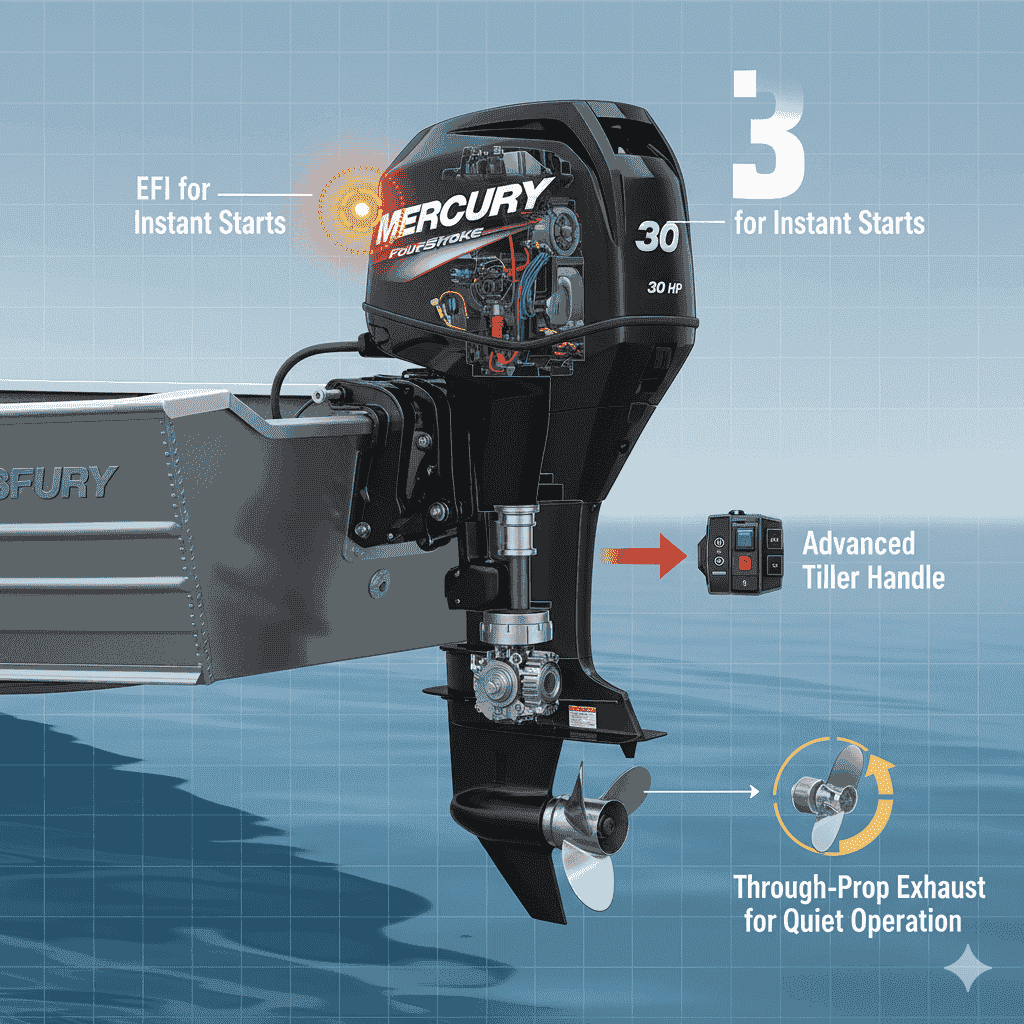
- Powerful 3-Cylinder Engine: The 526cc, inline 3-cylinder design is its core strength. This provides more torque for stronger acceleration and a smoother, more balanced operation compared to twin-cylinder engines.
- Electronic Fuel Injection (EFI): Mercury’s EFI system delivers reliable turn-key starts regardless of temperature, provides instant throttle response, and automatically optimizes the fuel-to-air mixture for excellent fuel efficiency.
- High-Output Alternator: It features a powerful 15-amp alternator that generates enough electricity to keep your starting battery charged while running electronics like a fish finder, GPS, and navigation lights.
Control and Ergonomics :
- Advanced Multi-Function Tiller Handle: This is a major user-friendly feature. It is designed to be comfortable and can be set up for left- or right-handed operation. It puts the shift lever, throttle, and stop button all in one convenient place for easy control.
- Through-Prop Exhaust: The exhaust is vented through the propeller hub, burying engine noise underwater. This results in a much quieter and more pleasant ride.
Durability and Protection :
- Engine Guardian System: This smart system uses sensors to monitor critical engine functions. If it detects a potential problem like overheating or low oil pressure, it will alert you and automatically reduce engine power to prevent serious damage.
- Superior Corrosion Resistance: Mercury uses a proprietary low-copper aluminum alloy (XK360) and a multi-step paint process. This provides industry-leading protection against corrosion, making the engine extremely durable in both freshwater and saltwater.
Maintenance and Convenience :
- No-Spill Oil Change System: This system is designed to make routine oil changes cleaner and easier for the owner by preventing spills and drips.
- Freshwater Flushing Port: An easily accessible port allows you to connect a standard garden hose to flush out salt and debris from the cooling system, which is crucial for extending the engine’s life.
- Easy-to-Access Filters: The fuel filter is designed to be easily accessible for quick and simple replacement during routine maintenance.
Putting Power to the Test: Mercury 30 HP Performance Metrics
While specs on paper are important, the real test of an outboard is how it feels on the throttle. The Mercury 30 HP is built not just to be a workhorse, but to provide exhilarating power and confident control. Here’s a breakdown of how it excels in the most critical performance areas.

Speed and Acceleration :
This is the primary performance advantage of the Mercury 30 HP. It is powered by a 30 horsepower, 526cc inline 3-cylinder engine.
- Acceleration: The engine’s larger displacement and extra horsepower provide a significantly stronger “hole shot” (the initial acceleration from a standstill). It gets boats on plane faster than a 25 HP, especially when the boat is loaded with passengers or heavy gear.
- Top Speed: On the same boat, the Mercury 30 HP will achieve a noticeably higher top speed than the Yamaha F25. Depending on the boat’s size and weight, it can push vessels to speeds approaching, or even exceeding, 30 miles per hour.
Fuel Efficiency :
Despite its focus on power, the Mercury 30 HP delivers excellent fuel economy thanks to its modern Electronic Fuel Injection (EFI) system.
- Fuel Consumption: While it will naturally use more fuel at full throttle than a lower horsepower engine, its efficiency at mid-range cruising speeds is excellent. The EFI system constantly adjusts the fuel mixture, ensuring it only uses what is necessary.
- Balance of Power and Economy: The engine provides a great balance between performance and fuel consumption. Because it doesn’t have to work as hard as a smaller engine to maintain cruising speed, it can often be surprisingly efficient for its power output.
Handling and Maneuverability :
The Mercury 30 HP is designed to provide solid, confident control on the water.
- Control: The advanced multi-function tiller handle is a key performance metric. It provides precise, ergonomic control over throttle and shifting, allowing the operator to manage the engine’s power smoothly.
- Stability: The engine’s heavier weight (around 172 pounds) can contribute to a more stable and “planted” feel for the boat, especially when navigating through choppy water. The engine’s torque provides instant response for quick course corrections.
Noise and Vibration :
The Mercury 30 HP performs exceptionally well in this area due to its engine design.
- Vibration Level: The inline 3-cylinder design is naturally better balanced and smoother than a twin-cylinder engine. This results in significantly less vibration felt through the tiller and the boat, especially at idle and trolling speeds.
- Noise Level: The engine is very quiet. The through-prop exhaust system vents fumes and sound underwater, which dramatically reduces engine noise for the operator and passengers, making for a much more comfortable and conversation-friendly ride.
Engineered for the Long Haul: Mercury 30 HP Reliability and Durability
Mercury has built its reputation on producing tough, powerful engines that can withstand demanding conditions. The 30 HP FourStroke is engineered with this same philosophy, focusing on robust construction and smart technology to ensure it lasts for years.

Construction and Corrosion Resistance :
- Advanced Materials: Mercury uses a proprietary low-copper aluminum alloy, known as XK360, which is extremely resistant to corrosion in saltwater environments.
- Superior Paint Process: The engine is protected by a multi-step painting process that creates a tough, sealed barrier against the elements, preventing chipping and bubbling.
- Heavy-Duty Components: The internal components are built to be more robust to handle the engine’s higher power output, ensuring they can withstand the stress of hard use.
Engine Design and Technology :
- Proven Engine Design: The single-overhead-cam (SOHC) and 3-cylinder design is simple, efficient, and well-balanced. With fewer moving parts than more complex designs, it has a long track record of reliability.
- Engine Guardian System: This is a key feature for long-term durability. The smart system uses multiple sensors to monitor critical engine functions. If it detects a problem like low oil pressure or overheating, it will sound an alarm and automatically reduce power to prevent catastrophic damage.
- Reliable EFI System: The Electronic Fuel Injection system is a mature and dependable technology that eliminates the common reliability issues associated with older, carbureted engines, such as fuel blockages and hard starting.

Maintenance and Long-Term Care :
- Easy Maintenance: The engine is designed with user-friendly maintenance in mind. Features like the no-spill oil change system and an easily accessible fuel filter make routine service clean and simple for owners.
- Freshwater Flushing Port: A convenient port allows you to connect a garden hose to flush out salt, sand, and other debris from the cooling passages, which is one of the most effective ways to prevent long-term corrosion.
- Large Service Network: Mercury has a vast network of dealers and certified service centers, ensuring that parts and professional support are readily available, which contributes to the engine’s long-term health.
Real-World Reputation :
- Workhorse Status: Mercury engines are widely regarded as powerful workhorses, trusted in both recreational and light commercial applications where dependability is essential.
- Owner Trust: Owners consistently praise the 30 HP for its raw power and its ability to perform reliably day after day. It’s an engine that gives boaters the confidence to handle various conditions on the water.
The Mercury 30 HP: The Right Choice for Heavy Lifting
The Mercury 30 HP is the undisputed champion when raw power is what you need. It is best suited for more demanding applications, such as:

- Larger and Heavier Small Boats: For aluminum boats in the 14- to 16-foot range, especially those with floors, casting decks, and livewells, the extra horsepower and torque are essential.
- Handling Heavy Loads: If you consistently boat with multiple people, coolers, and lots of fishing or hunting gear, the Mercury will get your boat on plane with much less effort.
- Small Pontoon Boats: The high-torque output of the Mercury 30 HP is perfectly suited for pushing the less hydrodynamic hull of a small pontoon boat.
- Boaters Who Crave Speed: If getting to your spot quickly is important, the Mercury will deliver a significantly higher top speed compared to any 25 HP engine.
- Light Water Sports: The extra power gives you the potential to pull a child on a tube or small skis, something a 25 HP engine would likely struggle to do.
Mercury 30 HP: Pricing and Availability
The Mercury 30 HP FourStroke outboard motor is priced to offer a competitive balance of power and value. As of our latest update, the engine is available for $4,165.

This model is currently in stock and available for purchase in West Palm Beach, FL. For those looking to buy online or learn more about this engine, you can find it at the following link:
Buy the Mercury FourStroke 30 HP Outboard Engine
Given its performance capabilities and advanced features, this price point positions the Mercury 30 HP as a strong contender for boaters seeking maximum power and reliability in the portable outboard category.

The Final Verdict on Mercury 30 HP :
The Mercury 30 HP firmly establishes itself as the powerhouse of the portable class. Its clear advantage comes from its robust 3-cylinder engine, which translates directly into superior acceleration and top-end speed. This engine isn’t just about raw force; it’s also refined, offering a smoother and quieter ride with advanced features like the multi-function tiller handle and the protective Engine Guardian system.
The Mercury 30 HP is the ideal choice for the boater who refuses to be underpowered. If you have a slightly larger or heavier small boat, frequently carry multiple passengers, or simply crave that extra punch when you hit the throttle, this engine delivers. It confidently fulfills its promise of providing more muscle for your transom, making it a top contender for those who prioritize performance above all else.
Comparative Analysis: Yamaha F25 vs. Mercury 30 HP
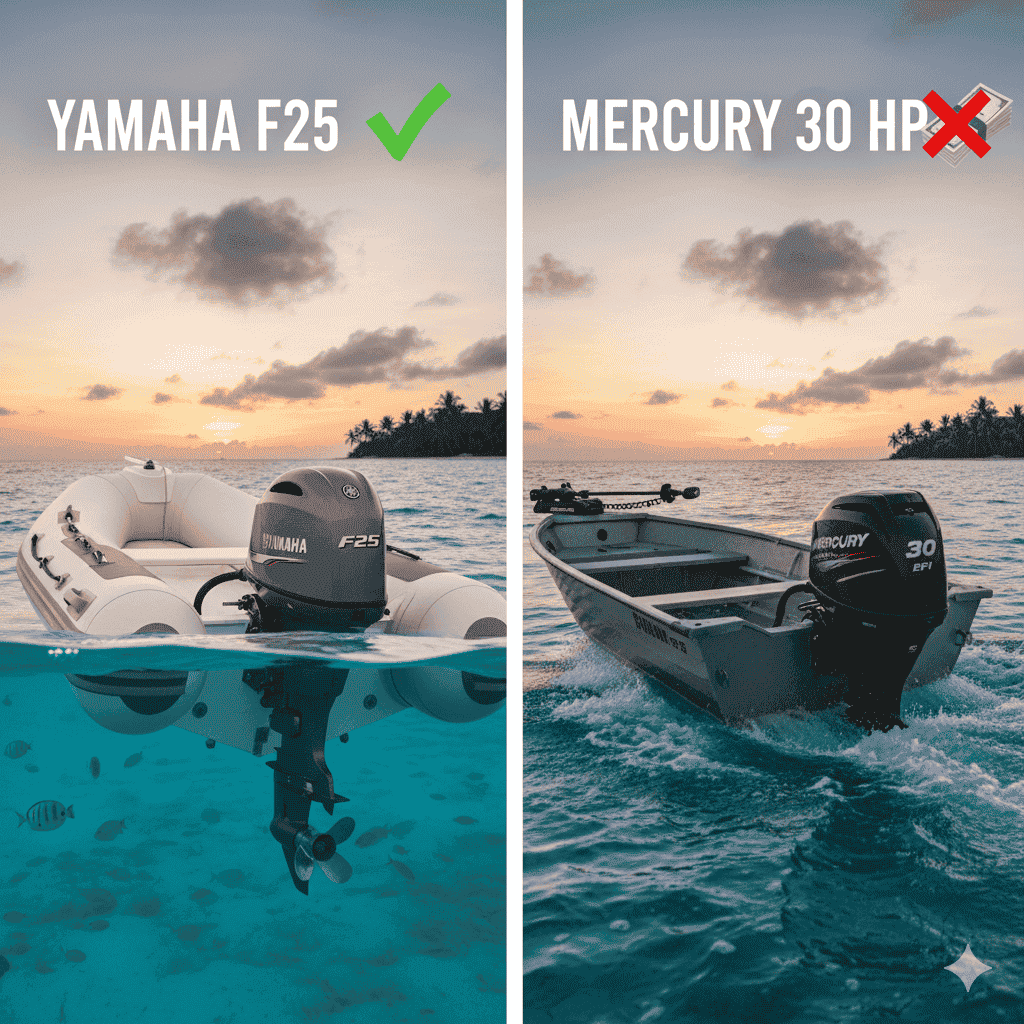
When you place the Yamaha F25 vs Mercury 30 HP side-by-side, their core design philosophies become clear. One prioritizes lightweight portability, while the other focuses on raw power. Here’s how they stack up in a direct comparison.
Yamaha F25 vs. Mercury 30 HP: Feature Comparison
| Feature | 2025 Yamaha F25SWHC3 | 2026 Mercury FourStroke 30 HP EFI |
| Engine Specifications : | ||
| Horsepower | 25 HP | 30 HP |
| Engine Type | 4-Stroke, SOHC | 4-Stroke, SOHC |
| Cylinders | 2-Cylinder | Inline 3-Cylinder |
| Displacement | 432cc | 526cc |
| Fuel System | Battery-less Electronic Fuel Injection (EFI) | Electronic Fuel Injection (EFI) |
| Cooling System | Water Cooled with Thermostat | Water Cooled with Thermostat |
| Ignition System | CDI Microcomputer | ECU Controlled |
| Alternator Output | 16 Amps | 15 Amps |
| Gear Ratio | 2.08:1 | 2.17:1 |
| Dimensions & Weight : | ||
| Dry Weight | Approx. 126 lbs (57 kg) | Approx. 172 lbs (78 kg) |
| Shaft Length | 15 inches | 20 inches |
| Control & Operation : | ||
| Starting System | Electric Start with Manual Backup | Electric Start |
| Control Type | Tiller Handle | Advanced Multi-Function Tiller Handle |
| Steering | Manual Tiller | Manual Tiller |
| Trim Method | Manual Trim with multiple positions | Manual Trim with multiple positions |
| Features & Design : | ||
| Color | Exclusive Brown Upgrade | Phantom Black |
| Engine Protection | Overheat & Low Oil Pressure Warning | Engine Guardian System |
| Maintenance Aids | Freshwater Flushing Port | Freshwater Flushing Port, No-Spill Oil Change |
| User Features | Variable Trolling RPM Switch (VTS) | Adaptable Left/Right Hand Tiller |
| Commercial Details : | ||
| Price | $3,700 | $4,165 |
| Availability | Deland, FL | West Palm Beach, FL |
Horsepower and Torque Comparison :
When you look at the specifications, the most obvious difference between these two outboards is in their power, but the story goes deeper than just the number on the cowling.
The Mercury 30 HP has a clear advantage on paper, offering five more horsepower than the 25 HP Yamaha. This difference is created by a more substantial engine design: the Mercury uses a 526cc, inline 3-cylinder engine, whereas the Yamaha uses a smaller 432cc, 2-cylinder engine.
- Horsepower and Top Speed: The extra 5 horsepower from the Mercury will directly translate into a higher top speed. On the same boat, you can expect the Mercury to be noticeably faster, which can make a real difference when you have a long way to travel.
- Torque and Acceleration: Torque is the rotational force that gets you moving, and this is where the Mercury’s larger displacement and extra cylinder make the biggest impact. The Mercury produces significantly more torque, which gives it a much stronger “hole shot”—the initial burst of power that gets the boat up and planing on top of the water.
- Load Carrying: This is where the torque difference is most crucial. If you often have multiple passengers, a lot of heavy gear, or a full livewell, the Mercury 30 HP will handle the weight with much less effort. It will get on plane more easily and maintain its speed without feeling strained. The Yamaha F25 is strong for its weight, but under a heavy load, it will have to work harder than the Mercury.
While the Yamaha F25 offers peppy performance for its size, it cannot compete with the raw power of the Mercury 30 HP. The Mercury’s advantage in both horsepower and torque makes it the clear winner for boaters who need superior acceleration, a higher top speed, and the ability to handle heavy loads with ease.
Winner: Mercury 30 HP
Weight and Size Differences :
In the world of portable outboards, weight is a critical factor, and this is where the Yamaha F25 and Mercury 30 HP are worlds apart. The decision between these two engines often comes down to this single metric.
The Yamaha F25 is a leader in its class for being exceptionally lightweight. The 15-inch shaft model weighs approximately 126 pounds.
In contrast, the Mercury 30 HP, with its larger and more powerful 3-cylinder engine, is significantly heavier, weighing in at around 172 pounds.
While the Mercury is more powerful, that power comes with a significant weight penalty. The Yamaha F25 was engineered with portability as a top priority, and it excels in this area. For boaters who need to move their engine frequently or have a smaller boat where balance is key, the Yamaha’s lightweight design is a massive advantage.
Winner: Yamaha F25
Noise Levels and Vibration :
While both the Yamaha F25 and Mercury 30 HP are modern four-stroke engines—meaning they are both significantly quieter and smoother than older two-strokes—there is a distinct difference in their character that you can both hear and feel.
The primary reason for this difference lies in their engine design. The Mercury 30 HP uses an inline 3-cylinder engine, while the Yamaha F25 uses a 2-cylinder engine.
Both engines are quiet enough to allow for easy conversation while underway. However, the Mercury 30 HP has a clear advantage in this category. Its 3-cylinder design is inherently smoother and produces a more pleasant, lower-pitched sound with less vibration. For boaters who are sensitive to noise and vibration and want the most comfortable ride possible, the Mercury is the superior choice.
Winner: Mercury 30 HP
Maintenance Requirements and Costs :
When it comes to keeping an outboard motor running for years, maintenance is key. Fortunately, both Yamaha and Mercury have designed these modern four-stroke engines to be reliable and relatively easy for owners to service.
Routine Maintenance:
Both the Yamaha F25 and the Mercury 30 HP follow a very similar maintenance schedule. As four-stroke engines, they require regular oil changes, just like a car. Typical routine maintenance for both will include:
- Engine oil and filter change
- Lower unit gear lube change
- Spark plug inspection and replacement
- Fuel filter replacement
- Water pump impeller inspection/replacement (every few years)
The service intervals are also nearly identical. Both manufacturers recommend an initial 20-hour service after the break-in period, followed by regular service every 100 hours of use or once a year, whichever comes first. For a DIY owner, the process and difficulty for these tasks are comparable on both engines.
Maintenance-Friendly Features:
Both brands have included features to make this process easier.
- Yamaha & Mercury: Both engines have a freshwater flushing port, which allows you to easily connect a garden hose to clean out the cooling system without having to start the engine. This is a critical feature for preventing corrosion and is a huge long-term benefit.
- Mercury: The Mercury 30 HP features a helpful “no-spill oil change system,” which is designed to make oil changes cleaner and less messy.
Long-Term Costs:
The long-term cost of ownership for both engines is expected to be very similar.
- Parts: The cost of common maintenance parts like oil filters, fuel filters, spark plugs, and water pump impellers is competitive for both brands. There is no significant price advantage for one over the other.
- Service Network: Both Yamaha and Mercury have extensive global networks of dealers and certified technicians. This means that no matter where you are, you can likely find parts and professional service easily.
In the category of maintenance, there is no clear winner. Both Yamaha and Mercury have created modern, reliable engines that are straightforward to maintain. The costs for routine parts and service are nearly identical, and both brands have a strong support network. Your long-term experience with maintenance will be very similar regardless of which engine you choose.
Winner: Tie
Yamaha F25 vs Mercury 30 HP: Real-World Owner Feedback
Since the engines are so close in size, the user experience often highlights the differences we discussed earlier: weight, features, and overall feel.
Here is a summary of customer reviews and real-world performance feedback for those models.
Customer Reviews for Yamaha F25 :
The modern Yamaha F25 is a popular choice, especially after the company made it significantly lighter in recent years.
| What Owners Praise | Potential Issues / Trade-Offs |
| Class-Leading Light Weight: The newer (post-2017) F25 is often praised as the lightest 25 HP engine, making it genuinely portable and easy to carry or mount. | Vibration at Idle: Some owners note that there is a slight increase in vibration at very low idle speeds, though it disappears once you throttle up. |
| Battery-less Electronic Fuel Injection (EFI): This is a huge positive. It means easy, reliable starting in all weather conditions without needing a cranking battery. No more problems with a dirty carburetor. | Premium Price: While the engine is highly regarded, it often carries a slightly higher price tag than competitors. |
| Variable Trolling RPM Switch (VTS): Tiller models have a small switch to fine-tune trolling speed in 50 RPM steps, which is great for fishing. | Intermittent Issues (Rare): A few reports of new engines having intermittent stalling issues when hitting waves (likely a fuel delivery system or water-in-fuel problem), though this seems to be an uncommon fault, not a widespread design flaw. |
| Durability and Resale: Owners trust the Yamaha name for long-term reliability and report high resale value. | Simpler Tiller (compared to Mercury): The tiller itself is excellent, but it does not have the same level of adjustability (left-hand/right-hand) that the Mercury tiller offers. |
You are buying a light, reliable, and smooth-running engine that is built to last, with the huge convenience of battery-less EFI.
Customer Reviews for Mercury 30 HP :
The Mercury 30 HP gives you an extra 5 horsepower over the F25 and is known for its strong performance and advanced features.
| What Owners Praise | Potential Issues / Trade-Offs |
| Power and Acceleration: Owners frequently praise the Mercury 30 HP for its robust torque and fast acceleration (often called “punchy” or “aggressive”), making it feel very powerful for its size. | Slightly Heavier (in this direct comparison): Because it is a 30 HP engine (compared to the 25 HP Yamaha), it will typically be heavier than the lightest F25 models. |
| Advanced, Adjustable Tiller: The multi-function tiller is highly praised for its ergonomics. It can be easily adjusted for left-hand or right-hand throttling and has great features like a power tilt/trim button. | Noise Level: While modern Mercury four-strokes are quiet, some owners note that the Yamaha might still be marginally quieter, especially at cruising speed. |
| SmartCraft Capability: The electric-start models can connect to Mercury’s SmartCraft digital gauges and VesselView Mobile app, giving you high-tech data, diagnostics, and features like Troll Control. | Dealer Network: While Mercury has a massive network, some users prefer the “built like a tank” reputation of Yamaha, noting that older Mercury models were less reliable (a reputation the new models are shedding). |
| Good Value: It often comes in at a more competitive price point than a comparable Yamaha model, offering great bang for your buck, especially considering the extra 5 HP. | Fuel Efficiency: The extra power comes with a trade-off; some reports suggest the F25 has a slight edge in miles-per-gallon (fuel efficiency) at mid-range RPMs. |
You are getting a powerful engine with excellent performance and the most advanced technology in the portable class, often at a slightly better value.
Your Questions Answered: Yamaha F25 vs Mercury 30 HP
Here are the answers to the most frequently asked questions when comparing these two excellent outboard motors.
Common Questions about the Yamaha F25 Outboard :
Here are some of the most common questions customers ask specifically about the Yamaha F25.
Do I need a battery for the electric start model?
Yes. While the EFI system itself is battery-less, you still need a battery connected to operate the electric starter motor if you have a model equipped with electric start. The manual pull-start will always work as a backup, even if the battery is dead or disconnected.
How much does the Yamaha F25 actually weigh?
The short shaft (15-inch) model, which is the most common, weighs approximately 126 pounds (57 kg). It is one of the lightest 25 horsepower four-stroke outboards on the market, making it significantly easier to carry and mount than many of its competitors.
Is the Yamaha F25 good for saltwater use?
Yes, it is excellent for saltwater use. Yamaha uses a proprietary aluminum alloy (YDC-30) and a multi-layer paint process that provides outstanding corrosion protection. It also has a built-in freshwater flushing port, which makes it very easy to clean out salt from the engine's cooling passages after each use, greatly extending its life
What is the Variable Trolling RPM Switch (VTS)?
VTS is a feature that is extremely popular with fishermen. It allows you to adjust the engine's trolling speed up or down in precise, 50-RPM increments with the simple push of a button. This gives you exact control over your boat's speed to match the perfect lure presentation.
What kind of fuel does the Yamaha F25 use?
The Yamaha F25 is designed to run on regular unleaded gasoline with an octane rating of 87. It is important to use fresh, clean fuel for the best performance and reliability.
How fast will the Yamaha F25 make my boat go?
Top speed depends heavily on the boat's size, weight, and shape. However, on a typical 14-foot aluminum jon boat, you can expect the F25 to achieve speeds of 20-25 miles per hour. It provides a strong, punchy acceleration that gets most small boats on plane quickly.
Common Questions about the Mercury 30 HP Outboard :
Here are the most common questions customers ask specifically about the Mercury 30 HP :
How much does the Mercury 30 HP weigh?
The Mercury 30 HP weighs approximately 172 pounds (78 kg). It is heavier than its 25 HP counterparts because of its larger, more robust 3-cylinder engine. This weight makes it better suited for boats where the engine is left on the transom, rather than being transported frequently.
What is the Mercury Multi-Function Tiller Handle?
It is an advanced, ergonomic tiller handle that puts all the main controls in one place. You can shift, steer, throttle, and stop the engine with one hand. It is also designed to be adjustable, making it comfortable for both left- and right-handed operators, which is a major advantage for convenience and control.
Is the Mercury 30 HP a reliable engine?
Yes, it is known for being very reliable and durable. Mercury engines are often considered "workhorses," and this model is no exception. It features Mercury's Engine Guardian system, which uses sensors to monitor the engine and will automatically reduce power to prevent damage if it detects a problem like overheating, giving you extra peace of mind.
Can I use the Mercury 30 HP in saltwater?
Absolutely. The engine is built for saltwater use. Mercury uses a special low-copper aluminum alloy (XK360) and a multi-step paint process for superior corrosion resistance. Like any outboard, it's crucial to use the built-in freshwater flushing port after every use in salt water to ensure a long life.
Why is the Mercury 30 HP so smooth and quiet?
Its smoothness comes from the inline 3-cylinder engine design, which is naturally better balanced and produces less vibration than a 2-cylinder engine. It is also very quiet because it uses a through-prop exhaust, which vents the engine noise underwater where it is muffled.
What type of gas does the Mercury 30 HP use?
The Mercury 30 HP runs on standard 87 octane unleaded gasoline. For best performance and engine health, it is always recommended to use fresh fuel from a reputable source.
The Final Verdict: Choosing Your Outboard Champion
After a head-to-head comparison, it’s clear that both the Yamaha F25 and the Mercury 30 HP are exceptional outboard motors that lead the pack in their own right. There is no single “king” in this matchup; instead, there are two champions built for two different types of boaters. The best engine is simply the one that aligns perfectly with your specific needs.
The decision boils down to one simple question: What is more important to you, power or portability?
Choose the Yamaha F25 if: you prioritize a lightweight, easy-to-handle engine. Its class-leading low weight and brilliant battery-less EFI system make it the undisputed champion of portability and convenience. It is the perfect match for jon boats, inflatables, and any situation where you need to transport your motor frequently.
Choose the Mercury 30 HP if: your primary need is raw power. Its larger 3-cylinder engine delivers superior acceleration and top speed, making it the clear winner for heavier boats, carrying multiple passengers, or simply getting where you need to go faster. It is the ideal choice for the boater who refuses to be underpowered.
Ultimately, both Yamaha and Mercury deliver on their promises of quality and reliability. By honestly evaluating your boat, your typical load, and how you plan to use your engine, you can confidently choose the right outboard and look forward to years of enjoyable time on the water.
 Share
Share